Acute and chronic pain conditions. We treat painas a medical condition with a cause, and tailor care to its source and severity.
Precise treatment, minimally invasive. Injections and interventions are guided by fluoroscopy or ultrasound to reach the source of pain precisely. Your doctor selects the right procedure after assessment.
If any of these apply to you, book an assessment with a pain consultant.
✓ Pain lasting more than three months.
✓ Pain spreading to the leg or arm, or with numbness.
✓ Painkillers no longer work as they used to.
✓ Pain is affecting your sleep, work or daily movement.
✓ Recurrent headaches or migraines disrupting your day.

You can book directly via the unified number. Some insurers may require a referral, so please check your coverage when booking.
No. The clinic focuses on non-surgical care, including medication and minimally invasive procedures. If surgery needs to be considered, your doctor coordinates with the right specialty.
Most injections are done under local anesthetic and take a short time; most patients go home the same day. Your doctor explains the procedure and preparation beforehand.
Bring any previous imaging or reports, a list of your current medications, and your insurance card if you have one.
Book with a pain management consultant on our unified number
We assess and treat acute and chronic pain in children through an individualized plan that considers the child's age, medical condition, and psychological and social needs, in partnership with the child and their family.
Pain is a personal experience, and the child is the best person to describe it. We help children express their pain in a way that suits their age and communication abilities, and use the same scale at each visit to monitor improvement accurately.
We show the child a series of faces and ask them to point to the face that best represents how much pain they are feeling now—from the first face (no pain) to the last face (very severe pain). We ask the child about the intensity of the pain, not whether they feel sad or happy.
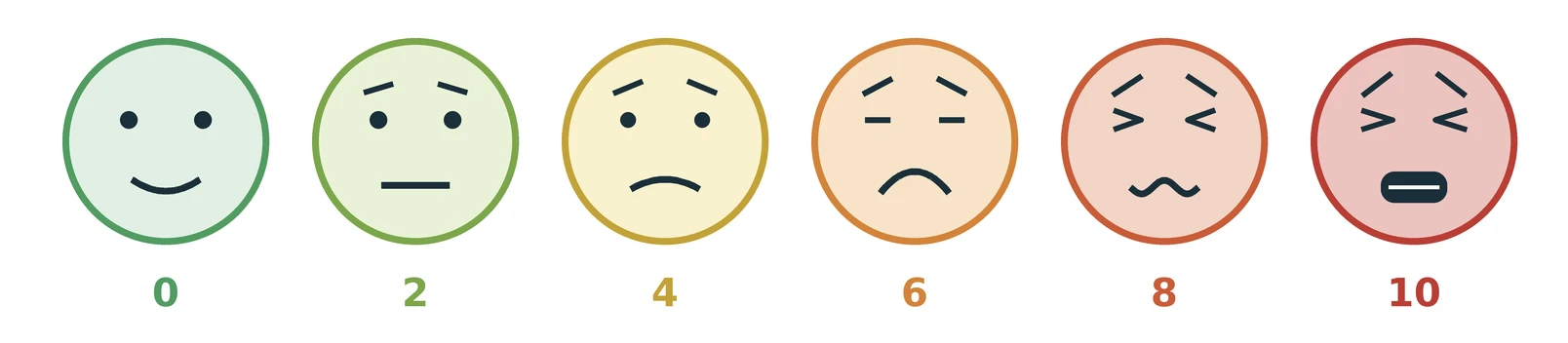
No pain → Increasing pain intensity → Very severe pain
The child chooses a number from 0 to 10, where 0 means no pain and 10 means the worst pain imaginable.

0 – No pain | 1–3 – Mild pain | 4–6 – Moderate pain | 7–10 – Severe pain
We observe the child's behavior, including facial expressions, crying, body movements, and ability to be soothed, using validated behavioral tools such as the FLACC scale. We also rely on parents' knowledge of their child, as you are best placed to recognize the specific signs they use to express pain.
We begin by listening to the child and family, taking a medical history, and performing a clinical examination. We use assessment tools suited to the child's age and communication abilities, such as faces and numeric rating scales, as well as behavioral observation tools for children who cannot express themselves verbally.
The assessment considers how pain affects sleep, movement, school attendance, mood, and family and social relationships. We also identify factors that may worsen the pain or help relieve it.
To relieve pain and improve the child's quality of life, support regular school attendance and reduce absences, and help maintain physical activity and connections with friends and family, according to the child's medical condition.
If any of these apply to your child, book an assessment with the pediatric pain consultant.
✓ Pain recurs or persists.
✓ Pain affects your child's sleep, school, movement, or mood.
✓ Pain is difficult to assess because of young age or communication difficulties.
You can book an appointment directly through the unified number. Some insurance companies may require a referral, so we recommend checking your coverage when booking.
No. Your child's pain is real, even when test results are normal. In some cases of chronic pain, the nervous system may become more sensitive to pain. Psychological and social stressors, such as anxiety or difficulties at school or in relationships, may increase the intensity of pain and its impact on a child's life. This does not mean the child is imagining the pain. We consider these factors as part of a comprehensive assessment and listen to the child and family to help the child develop skills to relieve pain, cope with it more effectively, and return to daily activities.
We carefully select medication and dosage according to the child's age, weight, and condition, and regularly monitor effectiveness and side effects. Strong painkillers are used only when truly necessary and under close supervision. In many cases of chronic pain, treatment does not rely on medication alone.
Yes. We make sure to listen to the child as well as the parents. One parent or the primary caregiver who knows the details of the child's condition is encouraged to attend.
Bring any previous medical reports, imaging scans, or test results; a list of the medicines your child takes and what has previously been tried to relieve the pain; and a daily pain diary, if available.
Book an appointment for your child with the Pediatric Pain Management Consultant by calling the unified number: